

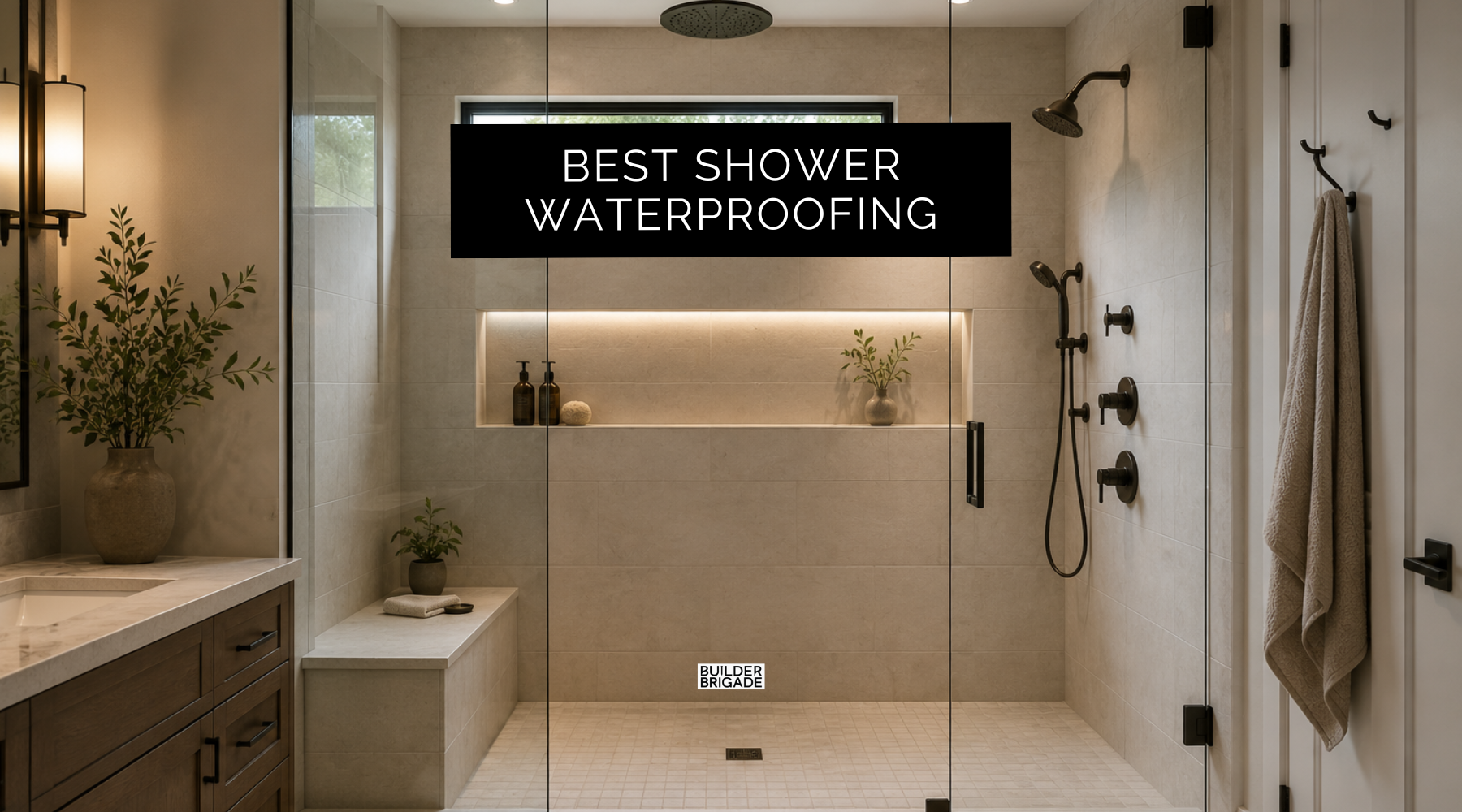
You’re going to spend a lot of time picking out shower tile.
I’d spend a few minutes figuring out what’s going behind it too.
Here are three common ways your shower may be waterproofed.

Good: Backer Board and Liquid Waterproofing
With this method, backer board goes over the studs to create a solid surface for the tile.
But the backer board itself isn’t the waterproof layer. A liquid waterproofing membrane is applied over the surface to create that barrier.
Coverage, thickness, corners, seams, and penetrations all matter. This isn’t a place where you want somebody stretching one bucket as far as humanly possible.

Better: Backer Board and Sheet Membrane
This starts with a solid backer too, but instead of relying on a liquid coating, a waterproof sheet membrane is bonded over the surface.
I like that you’re getting a more consistent waterproof layer rather than relying on someone applying a liquid membrane to the correct thickness everywhere.
The seams and transitions still have to be installed correctly, though. A great waterproofing product doesn’t help much if water finds its way through a poorly sealed corner, seam, or penetration.

Best: Waterproof Foam Board
This combines the backer and waterproofing into one system.
Waterproof foam boards attach directly to the framing and create a lightweight, tile-ready surface. You don’t have the separate step of covering an entire backer board with a liquid or sheet membrane.
There are still seams, fasteners, corners, niches, and plumbing penetrations that have to be sealed as part of the system.

Ask for a Flood Test Before Tile
Before the shower floor gets covered with tile, ask your builder about a flood test and what your local code requires.
The basic idea is pretty simple: the shower pan is filled with water and monitored to make sure the waterproofing holds before it gets covered.
If there’s a problem, I’d much rather find it while I can still see the waterproofing than after thousands of dollars of tile is installed.

Take Pictures Before They Cover It
This takes about 30 seconds and costs you nothing.
Take pictures of the entire waterproofed shower before tile goes up. Get the niche, corners, drain, valves, penetrations, and any benches.
You may never look at those photos again.
But if you ever have a leak, remodel the shower, or need to know what’s behind that tile, you’ll be really glad you have them.

Ask Before the Tile Goes Up
You don’t need to become a waterproofing expert.
I’d simply ask your builder, “What waterproofing system are you using in my showers, and are we doing a flood test before tile?”
That one conversation tells your builder you’re paying attention and gives you a chance to understand what’s going behind one of the most expensive finishes in your bathroom.
This is exactly the kind of detail I put in my Ultimate Home Building Checklist. You’re not going to remember every question you need to ask at every phase of a build, especially the stuff that disappears behind tile and drywall.